We use cookies, including third-party cookies from Google to serve personalized ads through AdSense, to operate this site and understand how it is used. By continuing to browse, you accept this use. See our Privacy Policy and Terms of Use for details, including how to opt out of personalized advertising.
Accept
SmartData CollectiveSmartData Collective
  • Analytics
    AnalyticsShow More
    What Kind of Problem-Solving Distinguishes Data Analysts From Software Engineers -- AI-generated illustration
    What Kind of Problem-Solving Distinguishes Data Analysts From Software Engineers
    7 Min Read
    chatgpt image jul 21, 2026, 04 34 30 pm
    4 Core Benefits of Predictive Maintenance after Vibration Analysis
    10 Min Read
    How Does Data Mining Boost Customer Satisfaction in Logistics? Harnessing Analytics for Results -- AI-generated illustration
    How Does Data Mining Boost Customer Satisfaction in Logistics? Harnessing Analytics for Results
    11 Min Read
    chatgpt image jul 13, 2026, 04 23 45 pm
    How Data Analytics Helps Companies Improve User Engagement
    19 Min Read
    chatgpt image jul 13, 2026, 03 59 46 pm
    How Data Analytics Improves Multi-Location Search Strategies
    10 Min Read
  • Big Data
  • BI
  • Exclusive
  • IT
  • Marketing
  • Software
Search
© 2008-25 SmartData Collective. All Rights Reserved.
Reading: The Google Live Search Summary of Big Data
Share
Notification
Font ResizerAa
SmartData CollectiveSmartData Collective
Font ResizerAa
Search
  • About
  • Help
  • Privacy
Follow US
© 2008-23 SmartData Collective. All Rights Reserved.
SmartData Collective > Big Data > The Google Live Search Summary of Big Data
Big Data

The Google Live Search Summary of Big Data

Timo Elliott
Timo Elliott
6 Min Read
The Google Live Search Summary of Big Data
Illustration generated with FLUX.2 [klein 4B] via Cloudflare Workers AI.
SHARE

What do you get when you type “big data is” into Google Live Search? An interesting view into what people think about the term!

Contents
  • Big Data is Like Teenage Sex
    • Big data is like teenage sex: everyone talks about it, nobody really knows how to do it, everyone thinks everyone else is doing it, so everyone claims they are doing it…
  • Big Data Is Bullshit
  • Big Data is Dead
  • Big Data is Watching You

Here’s a quick run down / explanation of each of the entries with some links:

What do you get when you type “big data is” into Google Live Search? An interesting view into what people think about the term!

Here’s a quick run down / explanation of each of the entries with some links:

More Read

3 Big Hadoop Myths Dispelled
Big Data Symposium from TDWI – October 3rd in NYC
Best Practices For Big Data Management In Cloud Computing
What Trends Are In Store For Data Storage?
When Ideology Reigns Over Data

Big Data is Like Teenage Sex

This saying is usually attributed to Dan Ariely of MIT, who posted the following on Facebook:

Big data is like teenage sex: everyone talks about it, nobody really knows how to do it, everyone thinks everyone else is doing it, so everyone claims they are doing it…

The saying has been around for a few years, so the chances of that teenager actually doing what they say they’ve been doing have been rising steadily! More and more large organizations are indeed “really” doing Big Data – depending on how you define it. And that brings us to the next term…

Big Data Is Bullshit

The Global Language Monitor site has labeled big data the Top Tech Buzzword That Everybody Uses But Don’t Quite Understand, and a lot of people hate the term.

Among other things, critics point out that “big data” has been around for a long, long time. Here, for example, is a Google Books snippet of a “Marketing Communications” journal in 1913: “the reports and catalogues were there, but they were not arranged to give up the kind of information wanted.”

The most common “3Vs” definition of big data was created by analyst Doug Laney in 2001:

Big data is high-volume, high-velocity and high-variety information assets that demand cost-effective, innovative forms of information processing for enhanced insight and decision making.

But according to the New York Times, the person with the best claim to coining the modern sense of the term big data was John R. Mashey, chief scientist at Silicon Graphics in the mid-1990s. He used the term extensively in presentation such as this one from 1998: Big Data and the Next Wave of Infrastress. He explained:

“I was using one label for a range of issues, and I wanted the simplest, shortest phrase to convey that the boundaries of computing keep advancing…”

Big Data is The Future

As we’ve already pointed out, there are lots of different definitions of big data to disagree with, but one thing seems clear: there has been a big increase in our ability to store and analyze data with new technologies such as Hadoop and other “NoSQL” databases, and fast in-memory processing.

If you’re interested in futuristic examples of how people are using big data today, Rick Smolan’s book “The Human Face of Big Data” is a great place to start.

Big Data is Dead

Gartner believes that the term has reached the peak of “inflated expectations” and is ready to fall into the “trough of disillusionment.”
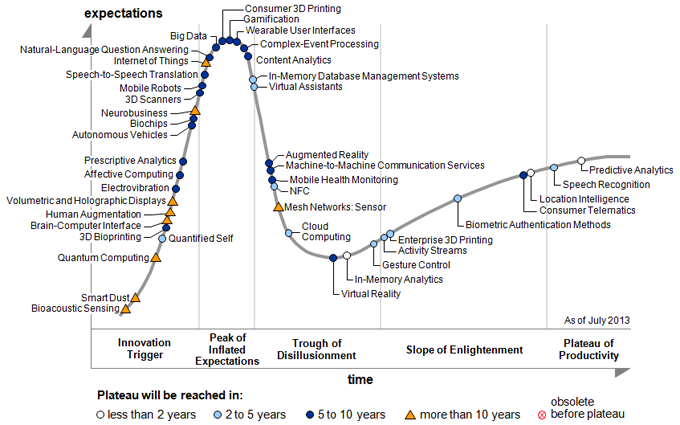
hype-cycle-pr-2013.png

Over time, we’ll probably stop talking about “big data” and just talk about “data.”

Big Data is Watching You

Rampant “datification” means that our every activity is being tracked by somebody, somewhere.

Our mobile phone and credit card transactions can give a scarily-detailed view into how we spend our daily lives. RFID chips in our passports, bank cards, and clothes can be automatically read as soon we get close enough to a sensor. Our cars are recording our speed and other data, ready to be used in the event of a crash (and European security experts are mulling the installation of mandatory “kill switches” that could stop cars at a distance). Cameras and face-recognition software track us as we walk down the street. Networked home appliances, or smart meters with smart algorithms, can get a real-time view of who is home at any moment, and what their activity is (the “signature” of a kettle, washing machine, computer, etc. are very different). Wearable technology such as Google Glass are raising concerns. Here’s the data websites receive when you use the “login with Facebook” option on their site:

And, of course, the NSA and other security agencies around the world that are storing all of that information, and more, in gigantic data warehouses, and can search up to several years in the past.

Big data is an incredibly powerful weapon. We must use it wisely and industry vendors should be in the forefront of addressing the ethical concerns.
Share This Article
Facebook Pinterest LinkedIn
Share

Follow us on Facebook

Latest News

Flat editorial illustration: The article's core relationship is the gap between raw bank-feed records and reliable subscription i
Subscription Trackers Have a Transaction Data Problem
Big Data Exclusive
Flat editorial illustration: The article's core relationship is the hypervisor as the abstraction layer that makes hybrid cloud p
7 Best Virtualization Platforms for Hybrid Cloud Environments
Big Data
Flat editorial illustration: The article's core relationship is between aggregated workplace data (occupancy, environmental, feed
How Businesses Can Use Workplace Data to Create Better Office Environments
Big Data Business Intelligence Exclusive
Flat editorial illustration: The article's core relationship is the engineering transition from an AI prototype to a production-r
From AI Prototype to Production: Observability and Scalability Requirements for Data-Heavy SaaS Applications
Artificial Intelligence Exclusive

Stay Connected

1.2KFollowersLike
33.7KFollowersFollow
222FollowersPin

You Might also Like

Social Data on the Top 4 Social Media Channels: How They Use Each Other
AnalyticsBig DataExclusiveSocial DataSocial Media Analytics

Social Data on the Top 4 Social Media Channels: How They Use Each Other

4 Min Read
How Nonprofits Like the YMCA Use Data to Maximize Community Impact & ROI
Best PracticesMarketingMarketing AutomationSocial Data

How Nonprofits Like the YMCA Use Data to Maximize Community Impact & ROI

6 Min Read
Current Trends in Big Data Usage in Large Industries
Big Data

Current Trends in Big Data Usage in Large Industries

7 Min Read
Big Data and the Wizard of Oz Syndrome
Big DataData Warehousing

Big Data and the Wizard of Oz Syndrome

4 Min Read

SmartData Collective is one of the largest & trusted community covering technical content about Big Data, BI, Cloud, Analytics, Artificial Intelligence, IoT & more.

ai chatbot
How AI Website Chatbots Improve Customer Support and Lead Generation
Chatbots Exclusive
AI chatbots
AI Chatbots Can Help Retailers Convert Live Broadcast Viewers into Sales!
Chatbots

Quick Link

  • About
  • Contact
  • Privacy
Follow US
© 2008-26 SmartData Collective. All Rights Reserved.
Welcome Back!

Sign in to your account

Username or Email Address
Password

Lost your password?