A company’s enterprise resource planning (ERP) system is one of the pillars of its record-keeping and process management architecture and is central to many of its critical functions. It is the heart of its accounting and financial record-keeping processes. In manufacturing and distribution, ERP manages inventory and some elements of logistics. Companies also may use it to handle core human resources record-keeping and to store product and customer master data. Often, companies bolt other functionality onto the core ERP system or extensively modify it to address limitations in the system.
A company’s enterprise resource planning (ERP) system is one of the pillars of its record-keeping and process management architecture and is central to many of its critical functions. It is the heart of its accounting and financial record-keeping processes. In manufacturing and distribution, ERP manages inventory and some elements of logistics. Companies also may use it to handle core human resources record-keeping and to store product and customer master data. Often, companies bolt other functionality onto the core ERP system or extensively modify it to address limitations in the system. Because of the breadth of its functionality, those unfamiliar with the details of information technology may perceive ERP as a black box that controls just about everything. So it’s not surprising that when a company’s information technology becomes more of an issue than a solution, many assume that the ERP system needs replacing. This may or may not be true, so it’s important for a company to assess its existing ERP system in the context of its business requirements (as they are now and will be in the immediate future) and evaluate options for it.
A common scenario for a company to replace its ERP system is because the business has outgrown (or will soon outgrow) its capacity to handle transaction volumes. Replacement also becomes necessary when the system no long meets business requirements, as, for example, when it is too difficult to configure to specific requirements. This issue might have developed because the company’s business model has changed significantly since purchasing the system or because it had to adjust its go-to-market strategy, added a new product line, expanded geographically or made an acquisition. Another reason to change may be that for a company with an adequate on-premises ERP system migrating to the cloud can eliminate a substantial portion of work done by its IT staff, enabling the department to focus on more strategic efforts, reduce headcount or both. A shift to the cloud also may improve the performance of an ERP system, especially if it’s an on-premises system running on aging hardware and the organization does not have the resources to maintain the system well.
Then, too, there are less obvious reasons that necessitate replacement. ERP systems are inherently complex, as I have noted, because they cross multiple business functions in many types of business, each of which has its own requirements. Seemingly trivial elements, such as the particular sequencing of tasks in a process by an ERP system, may be irrelevant for many businesses but have a negative impact on some. For example, when customer orders are almost always infrequent, it doesn’t matter when in the sequencing of the sales order process the system records the use of credit to confirm that the order can go through. An order must be rejected if adding it to the customer’s outstanding balance will bring the account over its limit. However, if orders occur frequently, the ERP system must execute the credit check at the first step or customers routinely will exceed their credit limits. It’s easy to overlook a detail such as this in the software selection process and even in the initial implementation. If that happens, dealing with the credit limit may require software customization or a process workaround if the root cause is the application itself. However, replacing the existing ERP system often is necessary if there are multiple issues such as these and the overall impact of them is severe enough to be measured by a combination of monetary losses, wasted time, lax controls, an inability to measure performance or limited visibility of information and processes.

At the same time, replacing the ERP system may not be the most cost-effective solution to business issues. To gauge that aspect, an important first step is determining whether the process or data issues identified by users are the result of a poorly executed implementation. Midsize companies in particular don’t always get the most competent consultants to set up their software, especially if the consultant (or the individual running the project) is not familiar with the peculiarities of the company’s industry or its specific operating requirements. Checking in with user group members in a similar business is an easy way to confirm if the issue is systemic or simply a poor job of setting up the software. If, based on feedback from other users, the situation appears dire enough, it may be worthwhile to engage a new consultant to fix the mistakes of the first one.
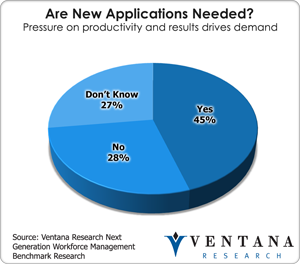 In some instances a “bolt-on” application (that is, software designed for easy integration with another, specific application) may be the most cost-effective way of addressing existing shortcomings. This is especially true for companies using a cloud-based system. Most ERP systems have rich functionality for handling core tasks such as accounting, human resources and inventory management. Yet the package a company is using may not have sufficient functionality for a specific process needed to run the business. For example, companies (particularly growing midsize ones) may find that their human resources department needs software to automate recruiting and onboarding of employees and that these capabilities are absent or insufficient in their ERP package. In our benchmark research on workforce management almost half (45%) of companies said they need new applications to address the full range of their human resources management requirements. In other cases, functionality necessary to manage the business may be missing. Companies that have a recurring revenue or subscription business usually find that the ERP system falls short of their requirements for invoicing. Bolt-on applications usually replace spreadsheets, ensuring that data is captured and available in a single controlled system where it can be accessed in an extended process (such as order-to-cash). Replacing desktop spreadsheets can save considerable time by automating tasks and eliminating the need to re-enter data into one or more systems. Having accurate and controlled data makes reports and metrics more reliable. It saves the finance and accounting departments time by eliminating the need to perform periodic reconciliations to ensure the accuracy of the data. Of course, the challenge with any bolt-on is that it is one more piece of software that requires attention, and integration with the core ERP system can pose challenges, especially over the long run.
 A company also may believe that it needs a new ERP system in order to consolidate data in a single system to facilitate analysis and reporting. In this instance, however, it may find that an operational data store, which integrates data from multiple sources for additional processing, will address all or most of its issues, especially if the company uses custom software or some niche application that supports its operations but is unavailable in an ERP system that otherwise meet its needs. A data store may prove to be a more practical choice because it’s much less costly and disruptive than replacing an otherwise well-functioning system. It also can provide flexibility in the longer term. As the company adds new applications, data from this new source can be fed into the operational data store. But be aware of challenges in setting up an operational data store or adding new system data feeds to it, using one usually requires an IT organization with the skills to maintain it over time.
Many companies are loath to replace an otherwise well-functioning ERP system because doing so is expensive and usually disruptive to operations. Also, implementing a new system almost always requires retraining and some adjustments in operating procedures. Our research on the Office of Finance finds that on average companies are keeping their ERP systems one year longer today than they did a decade ago. Deciding whether to replace an ERP system is not always straightforward. The process is made more difficult because today organizations have many more software and data options than they used to. Few companies have the expertise in-house that will enable them to decide the best course of action. There may even be vested interests within the organization that will prevent them from making the best choice. Finding a truly independent advisor that understands both information technology and the specific business requirements can be the best way to sort out the options and help make the difficult technology decisions.