
We use cookies, including third-party cookies from Google to serve personalized ads through AdSense, to operate this site and understand how it is used. By continuing to browse, you accept this use. See our Privacy Policy and Terms of Use for details, including how to opt out of personalized advertising.
Accept
SmartData CollectiveSmartData Collective
  • Analytics
    AnalyticsShow More
    What Kind of Problem-Solving Distinguishes Data Analysts From Software Engineers -- AI-generated illustration
    What Kind of Problem-Solving Distinguishes Data Analysts From Software Engineers
    7 Min Read
    chatgpt image jul 21, 2026, 04 34 30 pm
    4 Core Benefits of Predictive Maintenance after Vibration Analysis
    10 Min Read
    How Does Data Mining Boost Customer Satisfaction in Logistics? Harnessing Analytics for Results -- AI-generated illustration
    How Does Data Mining Boost Customer Satisfaction in Logistics? Harnessing Analytics for Results
    11 Min Read
    chatgpt image jul 13, 2026, 04 23 45 pm
    How Data Analytics Helps Companies Improve User Engagement
    19 Min Read
    chatgpt image jul 13, 2026, 03 59 46 pm
    How Data Analytics Improves Multi-Location Search Strategies
    10 Min Read
  • Big Data
  • BI
  • Exclusive
  • IT
  • Marketing
  • Software
Search
© 2008-25 SmartData Collective. All Rights Reserved.
Reading: How ICD-10 Will Unlock a New Market for Data Analysis
Share
Notification
Font ResizerAa
SmartData CollectiveSmartData Collective
Font ResizerAa
Search
  • About
  • Help
  • Privacy
Follow US
© 2008-23 SmartData Collective. All Rights Reserved.
SmartData Collective > Analytics > Predictive Analytics > How ICD-10 Will Unlock a New Market for Data Analysis
AnalyticsBig DataITPredictive Analytics

How ICD-10 Will Unlock a New Market for Data Analysis

Cameron Graham
Cameron Graham
4 Min Read
How ICD-10 Will Unlock a New Market for Data Analysis
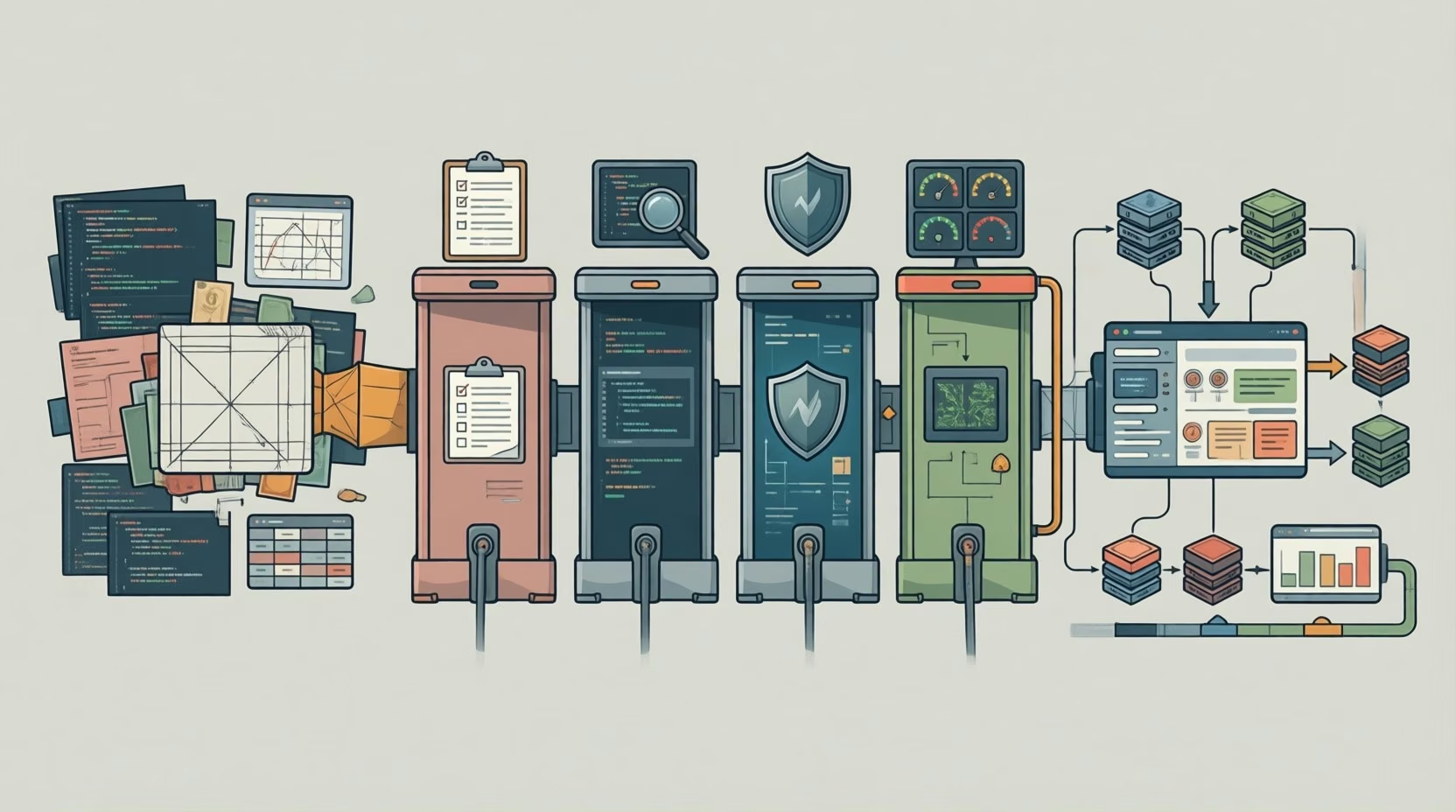
Illustration generated with Qwen Image.
SHARE

It’s not often that healthcare IT (sometimes referred to as HIT) makes national headlines.

It’s not often that healthcare IT (sometimes referred to as HIT) makes national headlines. Yet that’s exactly what happened after congress recently delayed the implementation of a new medical coding system (ICD-10) until 2015. This is actually the second time that Congress has delayed the switch from the current medical code system (ICD-9), to the latest version. Most other developed countries have been using it for years. Congress’ pushback was attributed to a variety of reasons, including the lack of EHR vendor support, and the small number of EHR solutions that are ICD-10 ready. In discussing the pros and cons of such a move, there’s one topic that tends to be glossed over – ICD-10’s impact on the data analytics market.


The healthcare industry is becoming increasingly interested in data analysis and predictive analytics. From healthcare providers to insurers (and now the federal government as well), every party has an interest in accurately predicting healthcare trends. Currently, most analysis focuses on identifying who is likely to be at risk for conditions such as diabetes, high blood pressure, or other ailments that often lead to larger consequences when left unmanaged.

More Read

Challenges of Chinese Natural Language Processing - Segmentation
Challenges of Chinese Natural Language Processing – Segmentation
Twitter and Text Analysis to Help You Surf Through Traffic
Design by the People: Testing reveals the most effective web designs
The specific benefits of business intelligence in Insurance
6 Important Big Data Future Trends, According To Experts

There’s less analysis taking place inside of hospitals, in regard to which procedures correlate to better patient outcomes. The reason for this largely lies with the current medical code system. ICD-9 has approximately 14,000 different codes, which are used to record what procedures are performed. The new system, ICD-10, has approximately 68,000.

The majority of these new codes are designed to help better track specialized procedures. In general, the new codes add clarification to things such as where certain conditions were found on the patient, what exact type of implants were used to correct a condition, or even just which side of the body was treated. These are crucial data points to have if you’re trying to, say, determine the effectiveness of a specialized knee implant. Delaying ICD-10 means that such analysis will remain on-hold. It also means that business intelligence companies are effectively locked out of this market for another year.

The healthcare industry is projected to spend $34.5 billion this year on IT related costs. The Centers for Medicare and Medicaid (CMS), forecast that health spending will account for almost 20 percent of the US’ GDP by 2022. Once ICD-10 is finally adopted, the amount of patient and procedure data that’s collected will vastly increase. As it does, there will be an even greater need for tools which can quickly analyze it, all the while maintaining strict security measures. In other words, ICD-10 adoption will open the floodgates for larger, comprehensive analytics reports.

Forward thinking EHR and EMR vendors are no doubt already laying the groundwork for implementation with leading business intelligence solutions. Such compatibility could allow providers to one day automatically track the effectiveness of specialized procedures simply by inputting their work into their normal EHR program. Likewise, BI companies that want to capitalize on this untapped market should be tailoring their software around medical workflows. After all, they’ve just been given a year long break to get ready.


photo credit: JonathanCohen via photopin cc
Share This Article
Facebook Pinterest LinkedIn
Share

Follow us on Facebook

Latest News

Flat editorial illustration: The article's core relationship is the engineering transition from an AI prototype to a production-r
From AI Prototype to Production: Observability and Scalability Requirements for Data-Heavy SaaS Applications
Artificial Intelligence Exclusive
Preparing Data Systems and Governance for a Scaling Global Gaming Brand -- AI-generated illustration
Preparing Data Systems and Governance for a Scaling Global Gaming Brand
Big Data Infographic
How Restaurant POS and Ordering Data Reveal Generational Customer Patterns -- AI-generated illustration
How Restaurant POS and Ordering Data Reveal Generational Customer Patterns
Exclusive Infographic
From Trucks To Data: How Telematics Can Improve Freight Transportation -- AI-generated illustration
From Trucks To Data: How Telematics Can Improve Freight Transportation
Big Data Exclusive Infographic

Stay Connected

1.2KFollowersLike
33.7KFollowersFollow
222FollowersPin

You Might also Like

Software Dependence & Model Accuracy
CRMData MiningPredictive Analytics

Software Dependence & Model Accuracy

4 Min Read
Twitter is Just One Piece of the Influencer Puzzle
Social Data

Twitter is Just One Piece of the Influencer Puzzle

6 Min Read
Where Do You Draw the Line Between Relevancy and Privacy?
Big DataMarketing AutomationPrivacySocial Data

Where Do You Draw the Line Between Relevancy and Privacy?

4 Min Read
5 Surprising Big Data Sources for Improving Data Quality and Business Analytics
Big Data

5 Surprising Big Data Sources for Improving Data Quality and Business Analytics

6 Min Read

SmartData Collective is one of the largest & trusted community covering technical content about Big Data, BI, Cloud, Analytics, Artificial Intelligence, IoT & more.

From Bolts to Bots: How AI Is Fortifying the Automotive Industry
Artificial Intelligence
AI chatbots
AI Chatbots Can Help Retailers Convert Live Broadcast Viewers into Sales!
Chatbots

Quick Link

  • About
  • Contact
  • Privacy
Follow US
© 2008-26 SmartData Collective. All Rights Reserved.
Welcome Back!

Sign in to your account

Username or Email Address
Password

Lost your password?