The Commoditization of Analytics[1]
The delivery of profit-boosting initiatives in a downturn economy has never been greater for Finance and Information Technology executives. The pressure on CFO and CIO to deliver cost-efficient and profit enhancing technologies is increasing daily. Executives must be able to know what areas have standardized processes that can be commoditized in order to reduce expenditures.[2] Outsourcing is looked upon as a way to reduce costs. Are analytics at a point that they could be commoditized? The answer is yes.

Analytics and metrics are based on mathematics and science. There is evidence that people in China knew mathematical concepts over 20,000 years ago. The Babylonians, Egyptians, Chinese, Indians, and Islamic mathematics brought us concepts like geometry, multiplication, division, trigonometry, prime numbers, linear equations, permutations, and square roots. All of these concepts were discovered and applied over 2,000 years ago.
The application of computer science principles is a relatively new field when compared with the application of mathematics. The aforementioned distinction is the keystone in understanding how the field of analytics should be treated as a commodity.
Companies with analytics products like Oracle/Hyperion (OBIEE), SAS Enterprise Data Miner, Microsoft Analysis Services (SQL 2005 and 2008), Business Objects IX, Cognos, and SPSS Clementine all have robust technologies that use mathematics to create applications that are used in industries like healthcare, financial services, marketing, CPG, manufacturing, and many other industries. Since the core mathematical analytical equations used in these commercial applications are essentially the same, the issue is not the analytics but the domain knowledge that the vendor can offer to a client.
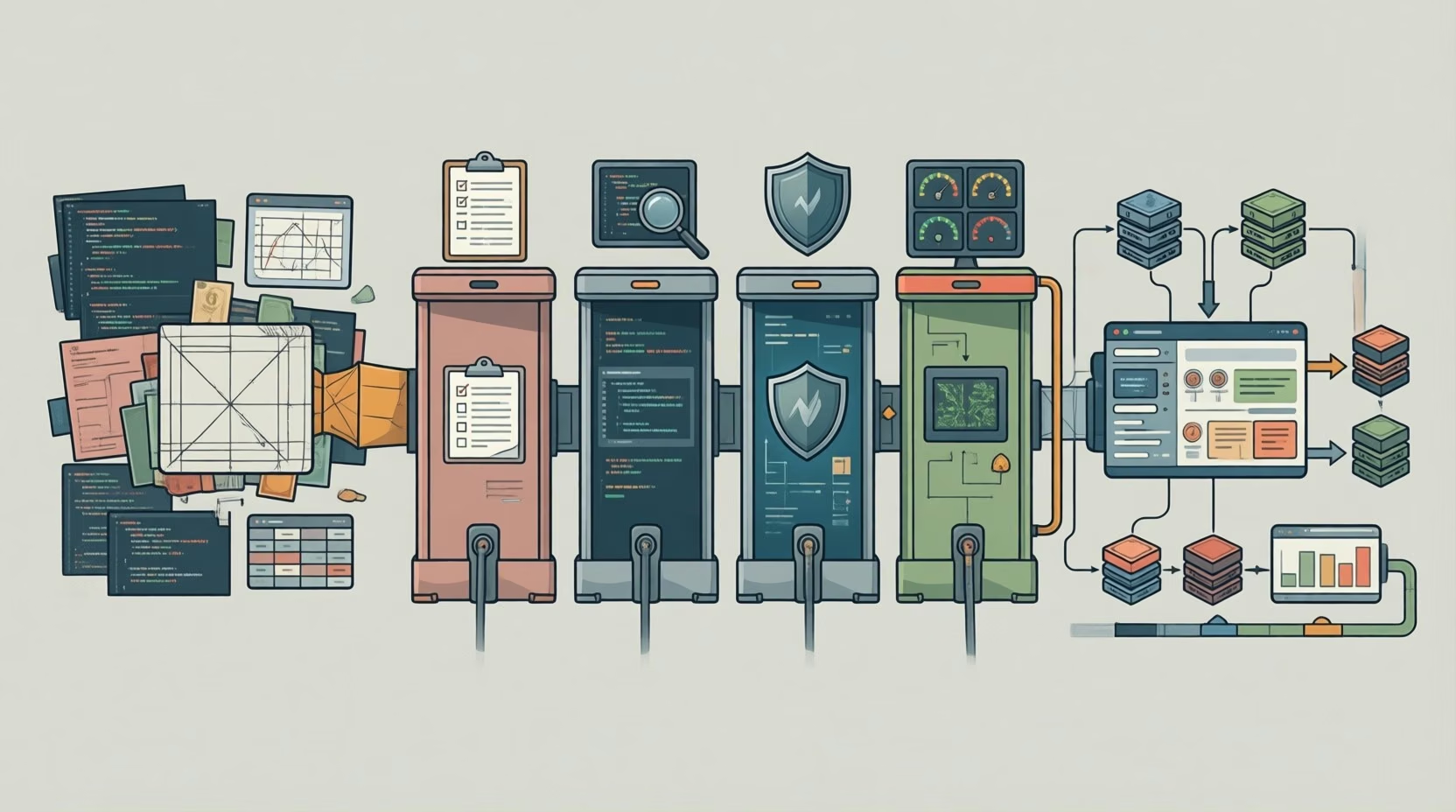
There are five different types of analytics that are the basis of a comprehensive business analytics program:
- Comparative Analytics – This area of analytics uses basic mathematical concepts like sums, subtractions, multiplication, correlation and division to compare key performance indicators (KPI) in an organization. For example, these concepts are used to compare and calculate revenue, expenditures, and profits during a specified time period. Also, correlation is used to compare the degree of similarity between two independent variables.
- Outlier Detection – This layer of analytics uses concepts like average, standard deviation, and Z-scores to determine whether a determined data point is abnormal in the same classification or category. Outlier detection analytics are used for fraud and abuse programs in the retail, financial services, telecommunications, manufacturing, and healthcare industries.
- Pattern Detection – This layer of analytics is the reverse side of outlier detection, but it uses the same methodologies. It is used in many industries to determine best practices. In the healthcare industry it is also used for outcomes research.
- Predictive Modeling – This area of analytics refers to the ability to create a score that determines the probability that an event will occur based on prior experience. Concepts like regression and neural networks are used to determine the relationship between different variables and the probability that a specific event will occur. Organizations use predictive modeling to do forecasting in many situations. In the healthcare industry, it is used for HCC reconciliation.
- Segmentation, Classification, Clustering and Spatial – This area of analytics is used to determine the different classes or categories among different variables. In the retail and market industries, it is used for categorization of customers using variables like level of spending, gender, geographical, and products. In the healthcare industry it is used in the analysis of different diagnoses like diabetes, cardiovascular, and cancer.
There are two additional areas in the commoditization of analytics that must be taken into account: visualization, and software-as-a-service (SaaS).
- The Visualization of Analytics – I have included this area as a separate entity in analytics because of its importance in the area of analytics. The brain is used to make decisions using visual clues. The ability to visualize large datasets using analytics has become a keystone of an organization’s decision support system. This is an area that is not commoditized and is continuously evolving. Some years ago reports were simple, but the large volume of data has created the need for robust visualizations as part of the reporting capabilities of an analytics system. The ability to have standard visualizations to make reports actionable is indispensable for the commoditization of analytics.
- Software-as-a-Service (SaaS) – In an economic recession costs must be accounted for and measured against revenues, expenditures, or profitability. SaaS is the most cost-efficient business model. The main issue is whether the SaaS vendor has the domain expertise needed to successfully implement analytics projects that can be measured.
As companies and organizations spend efforts to survive and, moreover, thrive in a recession, executives should keep in mind that they can increase revenues and profitability, or decrease cost by understanding the principles of commoditization of analytics. A company should be able to measure the impact of any decision support system in revenues or profitability whether the issue is predictive modeling, data mining, or any other type of analytics.
[1] The author of this article is Alberto Roldan, owner of R & R Analytics. Mr. Roldan has over 12 years experience in designing, implementing, and managing large scale analytics projects for Fortune 500 companies in the area of healthcare, financial services, supply-chain, and information technology.
[2] Thomas H. Davenport, The Coming Commoditization of Processes, Harvard Business Review, http://harvardbusiness.org/hbsp/hbr/articles/article.jsp?articleID=R0506F&ml_action=get-article&print=true